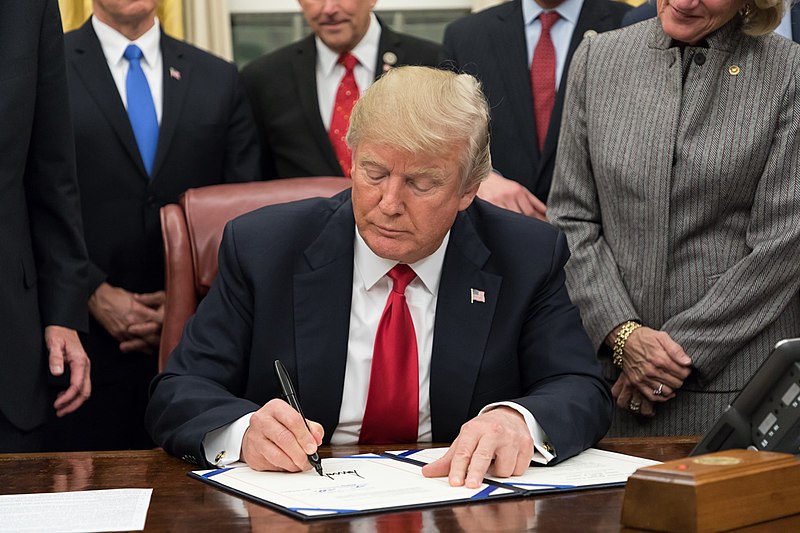
President Donald Trump signed an executive order Tuesday aimed at limiting Wall Street firms from buying single-family homes. The White House says the move is meant to make homeownership more affordable for American families and first-time buyers.
The order is titled Stopping Wall Street From Competing With Main Street Homebuyers. It directs multiple federal agencies to take steps to prevent large institutional investors from purchasing homes that could otherwise be bought by individuals.
Trump blamed high inflation and interest rates for pushing the American Dream out of reach. He said those conditions worsened under the previous administration. He also accused large investors of aggressively buying up homes meant for families.
“Hard-working young families cannot effectively compete for starter homes with Wall Street firms and their vast resources,” Trump said in the order. “Neighborhoods and communities once controlled by middle-class American families are now run by faraway corporate interests.”
Under the order, Treasury Secretary Scott Bessent and White House economic policy adviser Ryan Baasch have 30 days to define what qualifies as a “large institutional investor” and a “single-family home.” The Treasury Department is also instructed to review existing rules related to Wall Street firms acquiring or holding residential properties.
Several agencies are given 60 days to issue new guidance. These include the Departments of Agriculture, Housing and Urban Development, and Veterans Affairs. The General Services Administration and the Federal Housing Finance Agency are also involved.
Housing and Urban Development Secretary Scott Turner is directed to require owners of single-family rentals in federal housing programs to disclose ownership changes. The goal is to identify whether large investors are involved.
The order also tasks Attorney General Pam Bondi and Federal Trade Commission Chairman Andrew Ferguson with reviewing acquisitions by institutional investors. The administration says anti-competitive practices will be prioritized for enforcement. That includes coordinated vacancy and pricing strategies.
“Buying and owning a home has long been considered the pinnacle of the American Dream and a way for families to invest and build lifetime wealth,” the executive order states. “My administration will take decisive action to stop Wall Street from treating America’s neighborhoods like a trading floor and empower American families to own their homes.”
According to a 2024 Government Accountability Office study, institutional investors owned about 450,000 single-family rental homes by mid-2022. That represented roughly three percent of the national market. Companies such as Blackstone, American Homes 4 Rent, and Progress Residential expanded heavily after the 2008 financial crisis.
The order also directs federal programs to promote sales to individual owner-occupants. This includes “first-look” policies. Those policies allow individuals and non-institutional buyers to purchase foreclosed homes before large investors.
The White House said it will prepare legislative recommendations to codify the new restrictions. The goal is to prevent large institutional investors from acquiring single-family homes in the future.
Trump has recently taken other housing-related actions. Earlier this month, he directed Fannie Mae and Freddie Mac to purchase $200 billion in mortgage-backed securities. The administration says the move is intended to lower borrowing costs.
Housing data remains mixed. Redfin reported that the median U.S. monthly housing payment fell to $2,413 in early January. That figure is down 5.5 percent from a year earlier.
At the same time, the median home sale price rose to $380,606. Builder confidence also declined in January. The National Association of Home Builders/Wells Fargo Housing Market Index fell two points to 37.
The White House acknowledged that the full impact of the executive order remains uncertain. Officials said the policy makes clear that federal housing programs should prioritize families over corporations.
“People live in homes, not corporations,” the White House said.